





by Robert Hahn, CFA, on April 16, 2026
Over the Hedge is a 2006 animated film about a group of wild animals who wake up from hibernation to discover that a large part of the forest has been replaced by a housing development. Additionally, their winter food stash is lost, and they are forced to steal food from people in order to survive. A large hedge separates the human neighborhood from the remaining forest. The animals need to cross through the hedge to get food, but they are afraid of it.
A memorable part of the movie is when Penny the Porcupine says, “I’d be a lot less afraid of it (the hedge), if I just knew what to call it.” Hammy the Squirrel says, “ Let’s call it Steve!”
Similarly, many investors may be wary of hedging strategies that use options, such as hedge funds or hedged equity funds, and are unaware of their benefits and potential role within a portfolio.
Hedge Funds vs Hedged Equity Funds: What’s the Difference?
Hedge Funds
Many hedge fund strategies have the potential for lower correlation with broad equity markets; correlations, however, can vary significantly by strategy and over time. They are structured as private investment pools that require accredited investors. The core objective of most hedge funds is to generate returns that are less dependent on the direction of traditional equity markets, referred to as ‘absolute return’ strategies.
While returns of top funds can be strong, as a group, absolute returns tend to trail relative to market returns during extended bull markets. In addition, Hedge funds may involve limited liquidity, higher fees (traditional 2% management fee and 20% performance fee), and complex tax reporting, including Schedule K-1s.
Hedged Equity Funds
Hedged equity funds attempt to reduce the volatility of an equity portfolio while allowing investors to remain invested. While options can be used for speculation, hedged equity funds sell (or write) calls against a portion of the underlying portfolio. The premium received from call writing may help reduce volatility, it can also reduce upside participation during strong market advances though portfolio managers can partially write positions to have an unencumbered piece as well as roll in the money options.
In addition to call writing, puts and put spreads can be utilized to help reduce downside participation in larger sell-offs. Although puts may moderate downside capture, they may reduce overall returns in certain market environments.
While hedged equity funds typically have a higher correlation with the market, they offer daily liquidity in mutual fund or ETF structures, expense ratios are typically much lower than private hedge funds (no performance fee) and they can be managed more tax efficiently.
Participation and Volatility: What the Data Shows
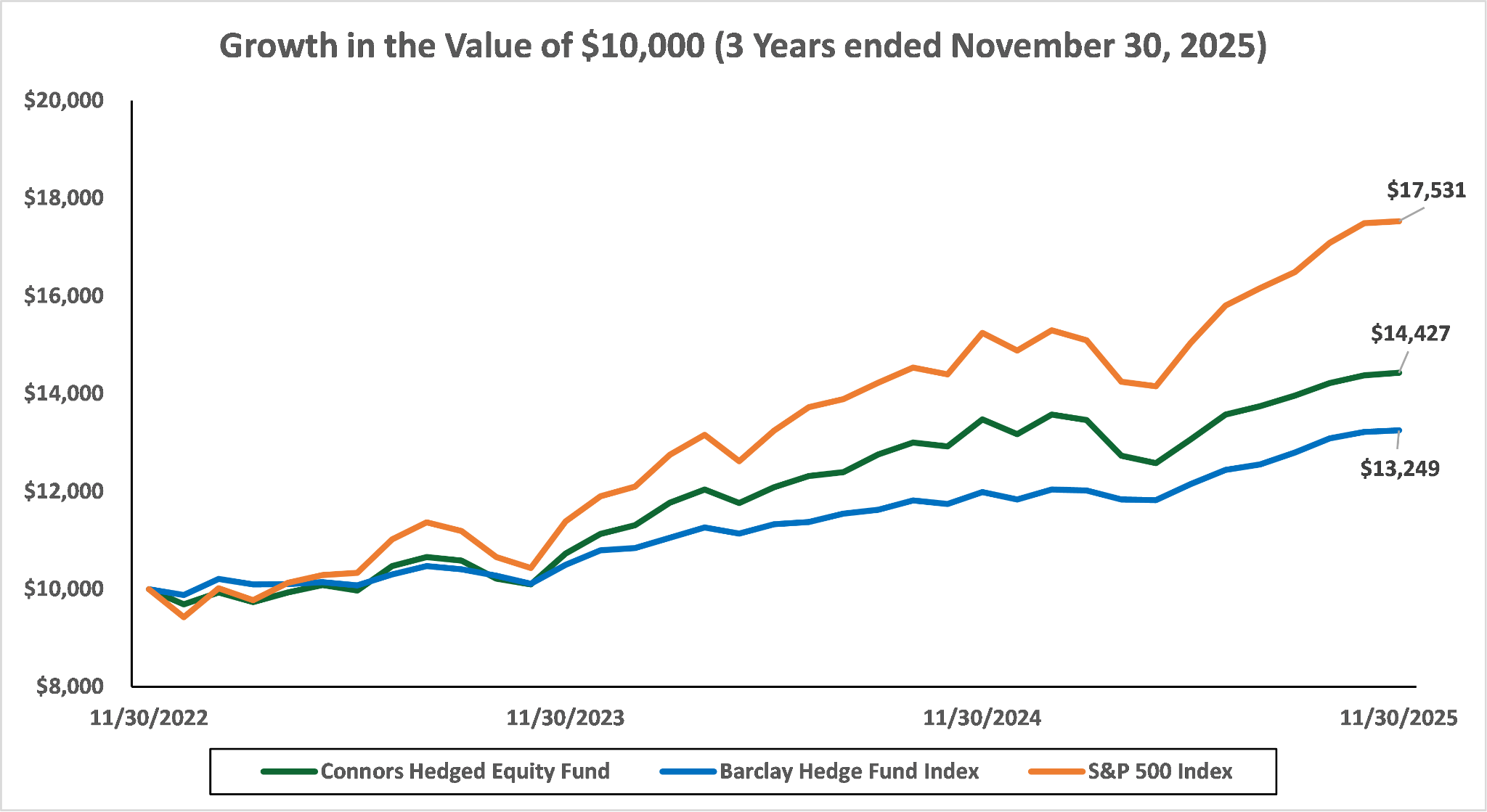
In terms of potential market appreciation, the following chart compares the growth of $10,000 in the S&P 500® Index, the Barclays Hedge Fund Index, and the Connors Hedged Equity Fund over the three-year period from November 2022 through November 2025. We point out that at the end of the three-year period, the Connors Hedged Equity Fund had 82% of the return of the market as represented by the S&P 500.
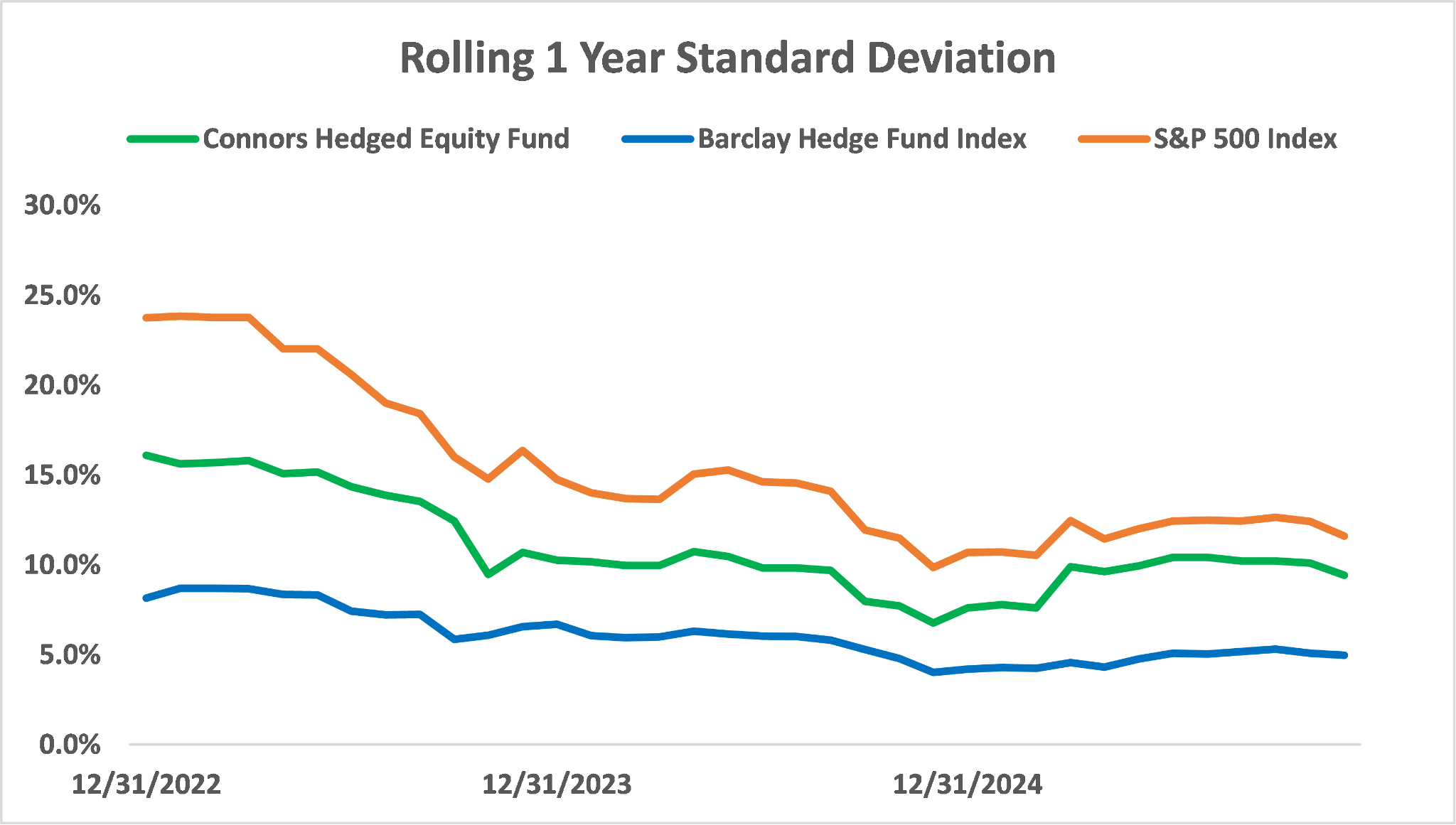
While hedged equity funds aim to capture a significant portion of equity market returns, reducing volatility is the other half of the equation. The next graph plots the rolling one-year standard deviation of the Connors Hedged Equity Fund, the Barclays Hedge Fund Index, and the S&P 500. During the period referenced, the Fund exhibited a lower rolling one-year standard deviation, which remained well below that of the S&P 500, particularly during periods of higher volatility. We note there can be no assurance that future volatility patterns will resemble those observed historically.
In closing, while we might not be ready to call our fund “Steve”, we hope that this discussion helped get you “over the hedge” and provided additional context around options-based strategies by illustrating some of the benefits of hedged equity funds, including their potential ability to allow investors to remain invested in the market while seeking a smoother return path along the way.
Frequently Asked Questions
How can hedged equity funds participate in potential market upside while writing calls?
Calls are written or sold against a portion of an underlying position. This leaves the unwritten portion unencumbered and able to fully participate in up markets. In addition, calls are written out-of-the money so that the written portion can participate in potential upside up to the strike price. Finally, calls can be rolled up to a higher strike price and out to a later expiration.
How can hedged equity funds be more tax efficient?
In-the-money calls can be rolled to a higher strike price and later expiration date. This has multiple benefits including greater potential upside participation, it maintains the tax basis of the underlying position and it creates a tax loss when closing out the in-the-money call option. In addition, rolls can often be done for a credit bringing in additional premium.
How do hedged equity funds attempt to reduce volatility and downside participation?
Hedged equity funds write calls against underlying positions to collect premium. This premium is cash in hand and therefore can offset some volatility in the underlying position. While call writing can reduce upside participation, in-the-money options can be rolled. Puts and put spreads are additional tool that can be used to reduce downside participation in bigger sell-offs. They can be actively managed to reduce drag in strong markets.
Where could a hedged equity product fit into an overall portfolio?
Many investment professionals utilize a sleeve of a hedged equity fund within their large cap allocation in an attempt to lessen volatility of the overall portfolio while still participating in a significant portion of potential market appreciation.
For Professional Use Only – not to be distributed to the general public
Investors should carefully consider the investment objectives, risks, charges, and expenses of the fund before investing. The prospectus contains this and other information about the fund, and it should be read carefully before investing. Investors may obtain a copy of the prospectus by calling 833-601-2676 or at www.connorsinvestor.com/mutual-funds. The Connors Hedged Equity Fund is distributed by Ultimus Fund Distributors, LLC, Member FINRA/SIPC. Ultimus Fund Distributors, LLC and Connors Investor Services are separate and unaffiliated.
IMPORTANT RISK INFORMATION:
As with any mutual fund investment, there is a risk that you could lose money by investing in the Fund. The success of the Fund's investment strategy depends largely upon the Adviser's skill in selecting securities for purchase and sale by the Fund, and there is no assurance that the Fund will achieve its investment objective. The Fund was formed in 2022 and has no operating history. In addition, although the principals of the Adviser have investment management experience, none have experience managing an open-end mutual fund prior to the Fund.
Investments in options involve risks different from, or possibly greater than, the risks associated with investing directly in the underlying securities. Option-based strategies are investment techniques that use call and put options to alter the risk-return profile of a portfolio, aiming to hedge risks, generate income, or speculate on market movements. These strategies involve buying or selling options—often in combination with underlying assets like stocks—to gain flexibility in volatile markets.
The S&P 500® Index is a capitalization-weighted unmanaged index of 500 widely traded stocks created by Standard & Poor’s. The index is considered a general representation of the stock market's performance. The Barclay Hedge Fund Index is a measure of the average return of all hedge funds (excepting Funds of Funds) in the Barclay database. The index is simply the arithmetic average of the net returns of all the funds that have reported that month. Indexes do not incur fees, and it is not possible to invest directly in an index. Standard Deviation measures the dispersion of a data set from its mean. It measures the absolute variability of a distribution; the higher the dispersion, the greater the standard deviation, and the greater the magnitude of the deviation of each value from its mean.
Please be advised that we cannot assure that any email or reply you send to us will be sent securely or any secure email from us that is forwarded to others will be sent securely. For your protection, each time you wish to email us any confidential information, please call ahead to request secure access for that email only. We will then send you an email to establish a secure channel for you to send us your information.
The information contained in this e-mail message is intended only for the personal and confidential use of the recipient(s) named above. If the reader of this message is not the intended recipient or an agent responsible for delivering it to the intended recipient, please notify us immediately by e-mail and delete the original message without any review/dissemination thereof.
This commentary is not intended for the giving of investment recommendations to any single investor or group of investors, and no investor should rely upon or make any investment decisions based solely on its contents. All returns are shown net of fees. The indices shown are for informational purposes only and do not reflect any investment. As it is not possible to invest in an index, the information shown does not reflect the features of an actual investment, such as objective, cost, and expenses, liquidity, safety, guarantees or insurance, fluctuation of principal or return, or tax features. The Strategy involves risk, including the possible loss of principal. The use of leverage embedded in written options will limit the Strategy's gains because the Strategy may lose more than the option premium received. Selling covered call options will limit the Strategy's potential gain on its underlying securities, and the Strategy continues to bear the risk of a decline in the value of its underlying stocks.