





by Robert Hahn, CFA, on September 24, 2026
The famous painter Vincent van Gogh once wrote "Great things are not done by impulse but by a series of small things brought together." Although Van Gogh was referring to artistic creation, the same principle applies to investing.
Long-term success is rarely the result of one decision, but rather a series of disciplined decisions made over time. As discussed in our previous blog, market pullbacks are a regular occurrence. We believe that hedged equity strategies can help investors remain invested through periods of heightened volatility, albeit at the cost of foregoing some potential upside. This raises the important question: Can a modest allocation to hedged equity improve the risk/return profile of an equity portfolio?
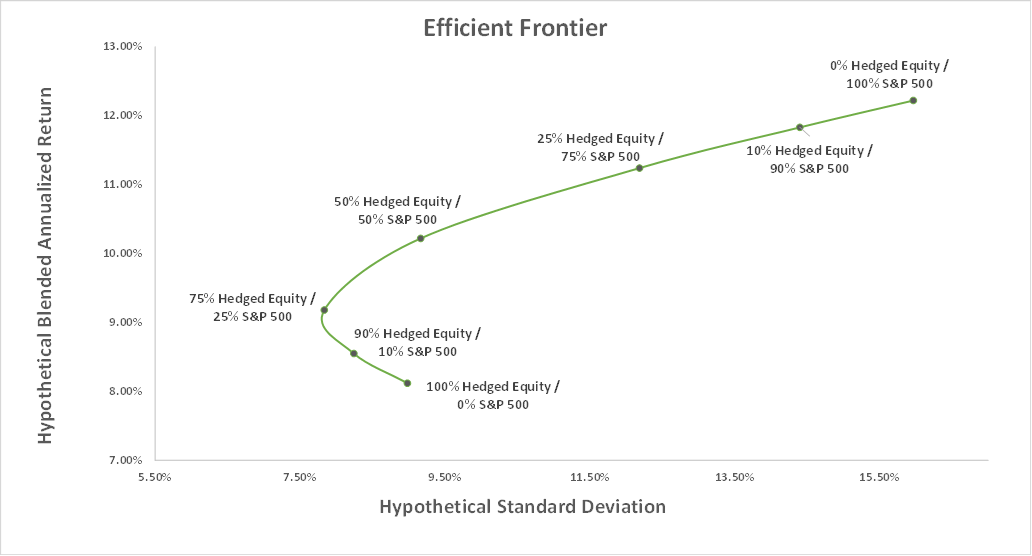
Harry Markowitz's Modern Portfolio Theory (MPT) demonstrates how combining assets with different risk and return characteristics can improve a portfolio through diversification. Rather than focusing solely on expected return, it seeks combinations of assets that maximize expected return for a given level of risk. The efficient frontier provides a graphical representation of these optimal portfolio combinations.
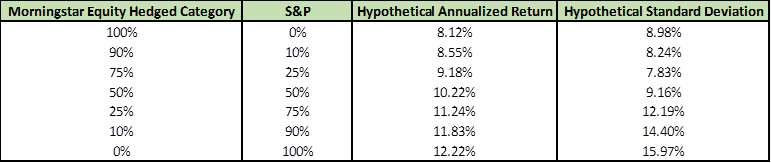
We applied efficient frontier analysis to evaluate how different allocations to Morningstar's Equity Hedged Category, when combined with the S&P 500, may influence a portfolio's risk and return. The results highlight one of the most powerful benefits of diversification: combining return streams with different risk and correlation characteristics may result in a hypothetical portfolio with lower volatility than either return stream individually. The analysis uses historical return, volatility, and correlation data from January 2022 through June 2026 to estimate the risk and return characteristics of each portfolio. In our analysis, the lowest volatility portfolio was a mix of 75% equity hedged and 25% S&P 500. In our analysis, even a relatively modest 25% allocation to the Morningstar Equity Hedged Category produced portfolio volatility more than 23% below the market portfolio while maintaining approximately 92% of the S&P 500's annualized historical return over the period analyzed. The benefit in this analysis comes not simply from adding a lower-volatility return stream, but from combining return streams with different risk, return, and correlation characteristics. Because hedged equity strategies may respond differently to changing market conditions, the combination can potentially improve the overall portfolio's risk/return profile.

Conclusion
The key takeaway from our analysis is not that investors need to choose between market participation and risk management, but that a modest allocation to hedged equity may complement an existing equity portfolio by potentially reducing overall volatility while maintaining meaningful participation in long-term market appreciation.
As Van Gogh observed, "Great things are not done by impulse, but by a series of small things brought together." For advisors, a modest hedged equity allocation may be one of those small changes that helps create a more balanced portfolio for clients.
IMPORTANT DISCLOSURE INFORMATION:
Please remember that past performance is no guarantee of future results. Different types of investments involve varying degrees of risk, and there can be no assurance that the future performance of any specific investment, investment strategy, or product (including the investments and/or investment strategies recommended or undertaken by Connors Investor Services, Inc. ["Connors]), or any non-investment related content, made reference to directly or indirectly in this commentary will be profitable, equal any corresponding indicated historical performance level(s), be suitable for your portfolio or individual situation, or prove successful. Due to various factors, including changing market conditions and/or applicable laws, the content may no longer be reflective of current opinions or positions. Moreover, you should not assume that any discussion or information contained in this commentary serves as the receipt of, or as a substitute for, personalized investment advice from Connors. No amount of prior experience or success should be construed as a certain level of results or satisfaction if Connors is engaged, or continues to be engaged, to provide investment advisory services. Connors is neither a law firm nor a certified public accounting firm, and no portion of the commentary content should be construed as legal or accounting advice.
Historical performance results for investment indices, benchmarks, and/or categories have been provided for general informational/comparison purposes only and generally do not reflect the deduction of transaction and/or custodial charges, the deduction of an investment management fee, nor the impact of taxes, the incurrence of which would have the effect of decreasing historical performance results. It should not be assumed that your Connors account holdings correspond directly to any comparative indices or categories. Please Also Note: (1) performance results do not reflect the impact of taxes; (2) comparative benchmarks/indices may be more or less volatile than your Connors accounts; and (3) a description of each comparative benchmark/index is available upon request.
Morningstar® Equity Hedged Category. The Morningstar Equity Hedged Category is a proprietary Morningstar category consisting generally of investment strategies that seek to maintain equity exposure while employing hedging techniques intended to reduce equity-market risk. Strategies within the category may use options and other derivatives, including puts, option spreads and collar strategies, and may differ significantly in their investment approach, exposures, risk characteristics and results. The Morningstar Equity Hedged Category is a category of investment funds and is not an index, investment product or investment strategy in which an investor can invest directly. As of June 30 2026, the Equity Hedged Category included 139 funds.
For purposes of this analysis, historical monthly return data for the Morningstar® Equity Hedged Category and the S&P 500® Index for the period January 2022 through June 2026 were used to construct hypothetical blended portfolios at the allocation percentages shown. The Morningstar Equity Hedged Category results represent aggregated category-level data and do not represent the performance of any individual investment fund, any Connors Investor Services, Inc. client account, or any actual portfolio. Individual funds within the category may have materially different investment objectives, holdings, strategies, expenses, risks, and performance.
The hypothetical blended results are provided for illustrative and educational purposes only and do not represent actual trading or performance achieved by any investor. Results were calculated by blending the monthly returns of the Morningstar Equity Hedged Category and the S&P 500® Index using the stated allocation percentages. Standard deviation measures the variability of monthly returns over the period presented. The results are based on historical information and assumptions regarding allocations and rebalancing and do not reflect investment management fees, transaction costs, taxes, or other expenses unless otherwise specifically stated.
Hypothetical performance has inherent limitations. Because the results were calculated retroactively, they may reflect the benefit of hindsight and do not reflect the impact that material market or economic factors may have had on actual investment decisions. Actual investment results may differ materially from those shown, and there can be no assurance that any allocation presented would achieve comparable results or levels of volatility in the future.
© 2026 Morningstar, Inc. All rights reserved. The Morningstar information contained herein: (1) is proprietary to Morningstar and/or its content providers; (2) may not be copied or distributed.
Investments in options involve risks different from, or possibly greater than, the risks associated with investing directly in the underlying securities. The S&P 500® Index is a capitalization-weighted unmanaged index of 500 widely traded stocks created by Standard & Poor's. The index is considered to represent the stock market's performance in general. Indexes do not incur fees, and it is not possible to invest directly in an index.
This commentary is not intended for the giving of investment recommendations to any single investor or group of investors, and no investor should rely upon or make any investment decisions based solely on its contents. The indices shown are for informational purposes only and are not reflective of any investment. As it is not possible to invest in the indices, the data shown does not reflect or compare features of an actual investment, such as its objectives, costs and expenses, liquidity, safety, guarantees or insurance, fluctuation of principal or return, or tax features. As it is not possible to invest in an index, the information shown does not reflect the features of an actual investment, such as objective, cost and expenses, liquidity, safety, guarantees or insurance, fluctuation of principal or return, or tax features. The Strategy involves risk, including the possible loss of principal. There is no assurance that the Strategy will achieve its investment objectives. The use of leverage embedded in written options will limit the Strategy's gains because the Strategy may lose more than the option premium received. Selling covered call options will limit the Strategy's gain, if any, on its underlying securities, and the Strategy continues to bear the risk of a decline in the value of its underlying stocks. The S&P 500® Index consists of 500 stocks chosen for market size, liquidity, and industry group representation. It is a market value-weighted index (stock price times the number of shares outstanding), with each stock's weight in the Index proportionate to its market value. It is widely used as a benchmark of U.S. equity performance. Standard deviation is a statistical measurement of volatility risk based on historical returns.